

In my early days, this is often how my day used to play out: The Service Desk team huddled around...
Most churn doesn’t start with a complaint. It starts with a confidence drop.
The customer still says “all good” in the service review. Tickets are still being closed. CSAT might even look fine.
But something shifts...
They start chasing more. They copy in more people. They get a bit sharper in tone. They stop engaging. And then, when renewal comes around, the conversation gets awkward and you realise you missed a bunch of red flags.
If you’ve ever been blindsided by a customer leaving “out of nowhere”, this is usually why.
This post isn’t about service quality metrics (I’ll cover the quality-to-churn link separately). This is about those red flags, the signals customers give you before they leave, and how to catch them early and turn them into owned action, without turning your week into a drama.
Why red flags matter (and why they’re easy to miss)
The Service Desk is busy, BAU is loud, and everyone is trying to be helpful, so red flags get normalised:
-
“They’re just a bit demanding.”
-
"They always chase.”
-
“They’re under pressure internally.”
-
“They’re a tricky customer.”
Maybe, BUT the risk is this: you start treating warning signs as “just how they are”, and you only react when the customer is already frustrated, or already gone.
The other reason they’re easy to miss is that most MSPs don’t have a simple place where these signals get captured and reviewed. They live in ticket notes, inboxes, Teams chats, and someone’s head. So even if one person spots the pattern, it doesn’t reliably turn into action.
If you want customer retention, you need stickiness. Not in a gimmicky way, but in a “customers feel looked after and stay” way. Stickiness comes from confidence, consistency, and follow-through.
What is “customer confidence”?
Customer confidence is simple:
-
They believe you’ve got it under control.
-
They believe you’ll tell them the truth.
-
They believe you’ll do what you said you’d do.
And here’s the bit MSPs sometimes miss: most customers already assume you can fix the tech. After all, you’re an IT company, so what they’re really judging is everything around it.
-
Do you own it?
-
Do you communicate?
-
Do you follow through?
-
Do you make it feel under control?
When confidence is high, users are patient, collaborative, and reasonable. When confidence drops, customers don’t always complain. They change behaviour, and that behaviour is your early warning system.
What are the quiet churn signals customers display before they leave
None of these red flags on their own mean “they’re leaving”. But patterns matter.
Communication red flags (tone and chasing)
This is the first place confidence shows up, because customers chase when they don’t trust the process is working.
Look for:
-
-
More “just checking…” messages than usual
-
Shorter replies, less warmth, more formality
-
More pressure for timelines (even when nothing has changed)
-
Customers asking for updates that should already be visible in your normal comms
-
Customers repeating themselves because they don’t believe the message landed
-
Engagement red flags (how they show up, or don’t)
When customers stop engaging, it’s rarely because everything is perfect, but a lot of MSPs interpret it that way.
We think the user's aren't calling, so things must be fine, and because we’re all busy, we don’t check in as much as the customer actually needs.
Look for:
-
-
Service review attendance drops (or becomes “just send it over”)
-
Key stakeholders stop joining calls
-
Slower approvals on changes/projects
-
They stop raising improvement ideas (apathy is a red flag)
-
They bypass your normal channels and go direct to individuals
-
Sometimes they just go quiet and you’re already done. No escalation. No drama. Just disengagement. You’re dead to them.
Escalation red flags (pattern, not severity)
Escalations aren’t always about technical severity. They’re often about confidence.
Look for:
-
-
More “urgent” labels for things that aren’t urgent
-
Escalations triggered by silence rather than failure
-
Repeat escalations on the same theme (updates, ownership, “who’s on this?”)
-
Escalations that jump levels quickly (Service Desk to Director) without a clear reason
-
Requests for a weekly ticket triage (where it starts to feel like the customer is trying to manage your team through you)
-
If the same type of escalation keeps happening, you’re not dealing with one-off incidents. You’re dealing with a trust gap.
Commercial red flags (money conversations shift)
Commercial pressure doesn’t always mean confidence has dropped. Sometimes the customer is just struggling financially, or they’re under pressure internally, but it is still a red flag, because it changes the relationship, and it’s often where customers start testing whether the service is delivering value.
Look for:
-
-
Increased questioning of invoices and line items
-
More scrutiny on what’s included vs what’s chargeable
-
Customers challenging what you’re saying (not to be awkward, but to make sure you’re correct)
-
“Can you throw this in?” becoming normal
-
Discount conversations starting earlier than renewal
-
Benchmarking language: “X does this”, “we’re speaking to another provider”, “what’s your best price?”
-
Customers leave because of cost or service. And this is often where the two collide: the service isn’t delivering value (or at least, the value isn’t visible), so cost becomes the lever they pull.
Internal actions after you spot a red-flag customer
This is the bit most MSPs are missing. You don’t need more heroics. You need a simple flow that makes sure red flags become owned action:
-
Signals: what are we seeing?
-
Triggers: what makes this worth acting on now?
-
Prioritisation: what matters most?
-
Ownership: who is accountable for the next step?
-
Action: what are we doing, by when?
Bear in mind:
-
If you only do signals (notice things), you get noise.
-
If you do signals plus triggers but no ownership, you get a good conversation and no change.
-
If you do everything except action, you get a status meeting.
Stickiness comes from doing the boring bits consistently. Seeing the red flags, deciding what they mean, assigning ownership, and following through.
How to know when to put a red-flag customer on a SIP
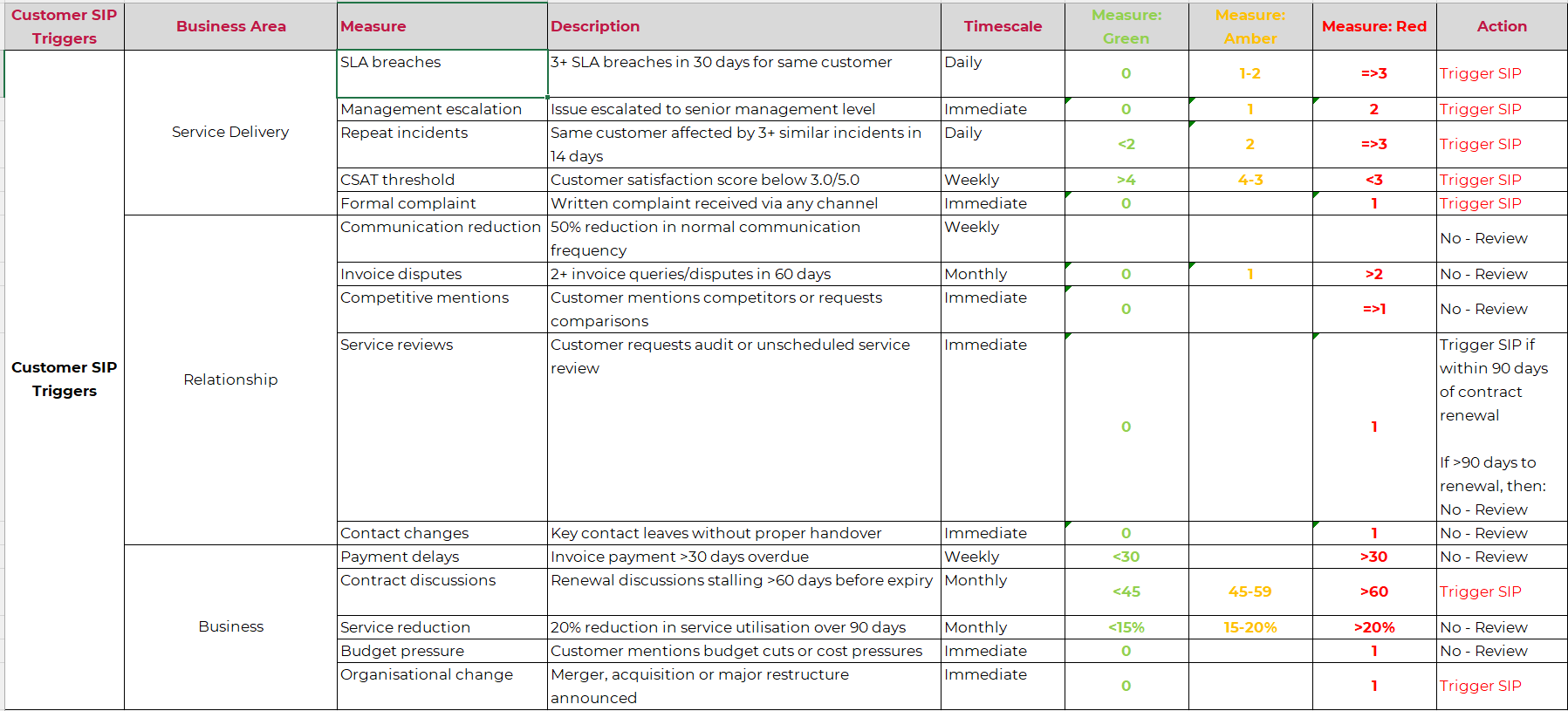
Not every red flag needs a full Customer SIP. Sometimes it’s a quick BAU fix and a tighter comms cadence, but if you're seeing any of these things above, it’s usually SIP territory, because the relationship is already at risk and you need a visible recovery plan.
Service Delivery triggers (SIP):
So how do you decide when a red flag is just “keep an eye on it”… and when it’s SIP territory?
Define a trigger matrix (I've copied a starting point below). Not because we love admin, but because the triggers will help you respond consistently, stop you overreacting on a bad day, or ignoring patterns until renewal time.
Customer-facing actions to stabilise an at-risk customer quickly
This is where MSPs either overreact or ignore it. The sweet spot is to remain calm, direct, and practical.
A red flag customer is simply an at-risk customer. Not because they’re “bad”, but because the relationship is wobbling and needs attention. This means no hiding behind a keyboard; pick up the phone or (if they're local) drop in to see them.
Name the pattern (without blaming)
You can say something like: “We’ve noticed there’s been a lot more chasing recently, and a couple of escalations around updates. I want to make sure we’re not missing something and that you feel confident in how we’re handling things.”
You’re not accusing anyone. You’re showing you’re paying attention.
Confirm what “good” looks like right now
Expectations shift. Stakeholders change. Pressure changes.
Ask:
-
-
“What would make you feel more confident over the next month?”
-
“What’s the one thing that would make the biggest difference right now?”
-
“Where do you feel we’re dropping the ball most often?”
-
Pick one visible fix fast
Confidence rebuilds through evidence. Choose one change the customer will feel within a week:
-
-
Tighter update cadence
-
Clearer ownership on escalations
-
A single point of contact for a specific issue
-
A short weekly summary for a month
-
A cleanup of recurring ticket categories so reporting tells the truth
-
Small, visible, delivered.
Decide: BAU fix or Customer SIP?
Not everything needs a formal plan.
-
-
If it’s a one-off fix with a clear owner and quick outcome - handle it in BAU.
-
If it’s a recurring theme, cross-team, or needs multiple actions - create a short Customer SIP.
-
If the trigger is a complaint, handle it as a complaint first, then feed it into the same improvement system. If you want to know how to handle a complaint, check out an article we wrote previously on: How to Convert Complaints into Service Improvement Opportunities.
Close the loop (this is where trust is won)
Don’t just do the work. Close it and communicate with the customer:
-
-
“Here’s what we changed.”
-
“Here’s what you should see differently now.”
-
“Here’s how we’ll stop it recurring.”
-
Customers don’t just want fixes. They want confidence that the fix will stick, and don’t rely on ticket updates alone. Communicate regularly outside of tickets too, a quick check-in, a short summary, a “here’s where we’re up to” message. It’s often the difference between a customer feeling looked after, and a customer feeling like they have to manage you.
If you’ve got more than one red flag customer at any time, put a weekly “Red-Flag Customer” review in the diary - non-negotiable time with the management team to track progress, keep comms consistent, and unblock what’s stuck.
Confident customers become sticky
Sticky customers lead to retention, and retention is profitability, and confidence is one of the earliest things to wobble. If you can spot red flags early and turn them into owned, visible action, you’ll prevent a lot of churn before it becomes a renewal crisis.
If you want to sanity-check your current approach to spotting red flags, or you want a simple way to capture signals and turn them into action, drop me a message.